 Anna Pershinadesigner
RU
Anna Pershinadesigner
RU
Anna Pershinadesigner
RU
Anna Pershinadesigner
RU
I’ve been designing interfaces since 2019. My current focus is research-heavy services, medtech and human-centered AI.
I work in narrow niches and dive deep into the subject matter — from embryologists’ workstations to systems that detect defects on aircraft skin. I’ve started many projects from scratch, in startups and research teams, so I’m used to looking at the product as a whole. My technical background makes it easier to work with developers, and my skills in illustration, 3D, animation, copywriting and prompt engineering let me create content on my own.
I untangle complex requirements and turn them into a clear working tool for people.
Supporting and updating the homepage. Designing and building landing pages for special projects. Designing marketing materials and creatives. Writing UI guidelines.
Designing web apps, microservices and nationwide products from scratch: creating and defending concepts, prototypes and UI. Building a design system for a suite of services. Supporting implementation and reviewing front-end builds. Taking part in UX research. Running Figma workshops for analysts and developers. Helping organize conferences.
Moderating the news feed on the homepage and in charts. Art direction for a junior designer: guidelines, checking visuals against the news context, checking licenses. Editing and creating images, generating them in Midjourney. Working with fellow editors from the London office.
Designing mobile and web apps for IT startups and accelerator projects from scratch to launch, including Skolkovo grant projects. Design expertise on internal projects. Working with front-end and back-end developers. Communicating with clients, presenting and defending design decisions. Supervising junior designers on Upwork.
Creating a web design course and curriculum. Giving lectures, running practical and lab classes, preparing presentations, adapting complex material. Tracking progress and keeping students motivated.
Quick-turnaround tasks for major companies: Sber, MKB, Alfa-Bank, Spires, VTB, Kaspersky, Mirpharm, Rosneft, Center-Invest, PEK and others. Illustrations, icon sets, raster work: photo compositing, retouching, cutouts, Photoshop scripts. Took part in 4 major tenders (won 2, including a VK tender). Presentations for the studio’s external and internal conferences, content for the corporate Instagram. Outstaffed to Sber’s product team: graphics for the website, ATMs, banners and ecosystem product sites.
Inventum AI is a web app in the Drug Discovery segment for medicinal chemists and R&D researchers. The platform uses end-to-end generative AI to design new drugs, with a focus on protein–ligand interactions.
The traditional drug development process takes enormous time and money. Inventum.AI tackles this: automation makes molecular design more accurate and lowers the entry barrier, making cutting-edge research accessible to a wider range of labs and organizations.
The project started in 2022: the first version had a different name and was built on knowledge graphs. In 2023 we rethought the platform, and it became Inventum.ai.
The user uploads a protein file and works with its parts step by step. Instead of a blind search, the system helps generate molecules purposefully, so they meet medicinal chemists’ strict criteria. This greatly increases the chances of new drugs successfully passing clinical trials.


⌘ or Ctrl + scroll — zoom, drag — pan
Tap to open the diagram
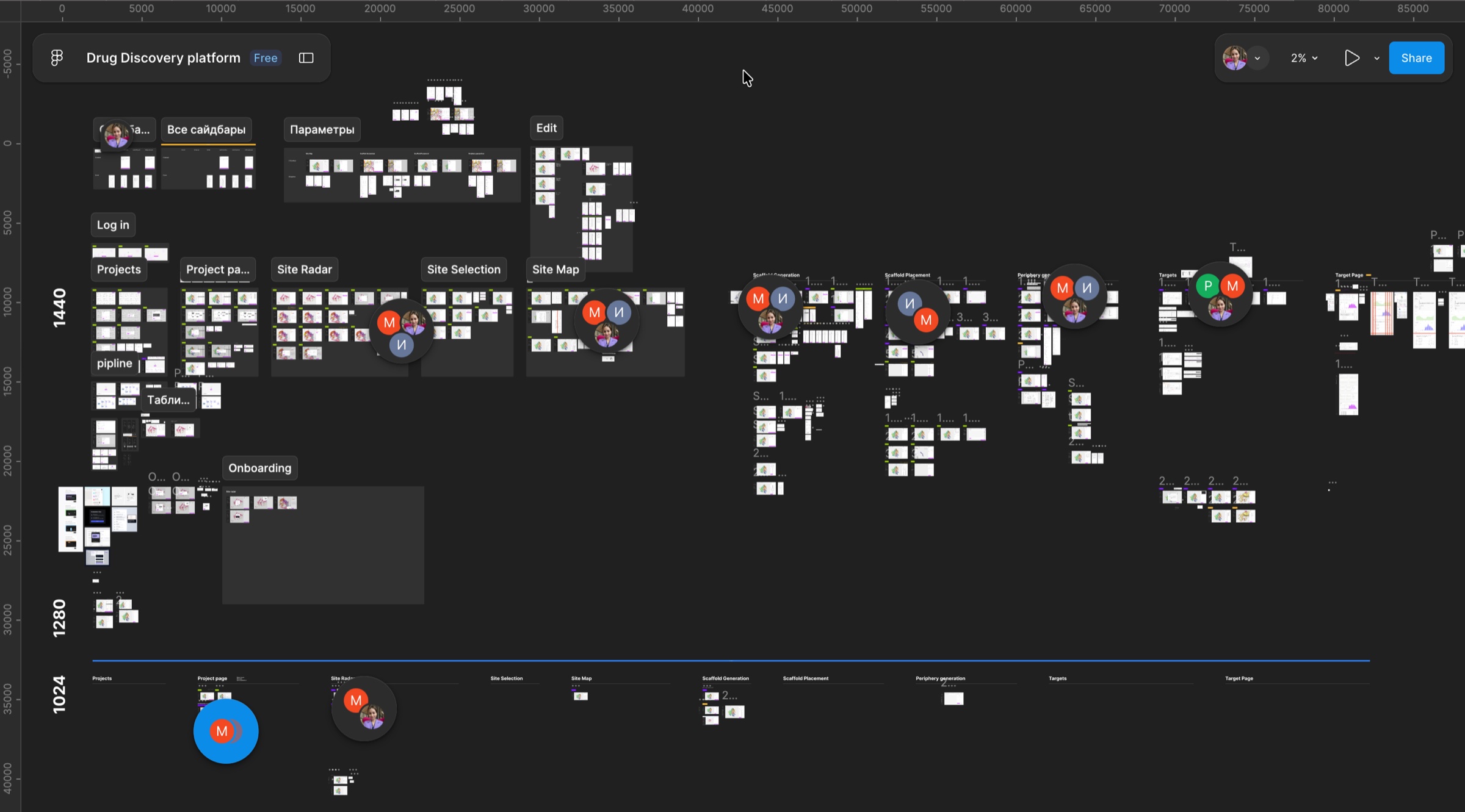
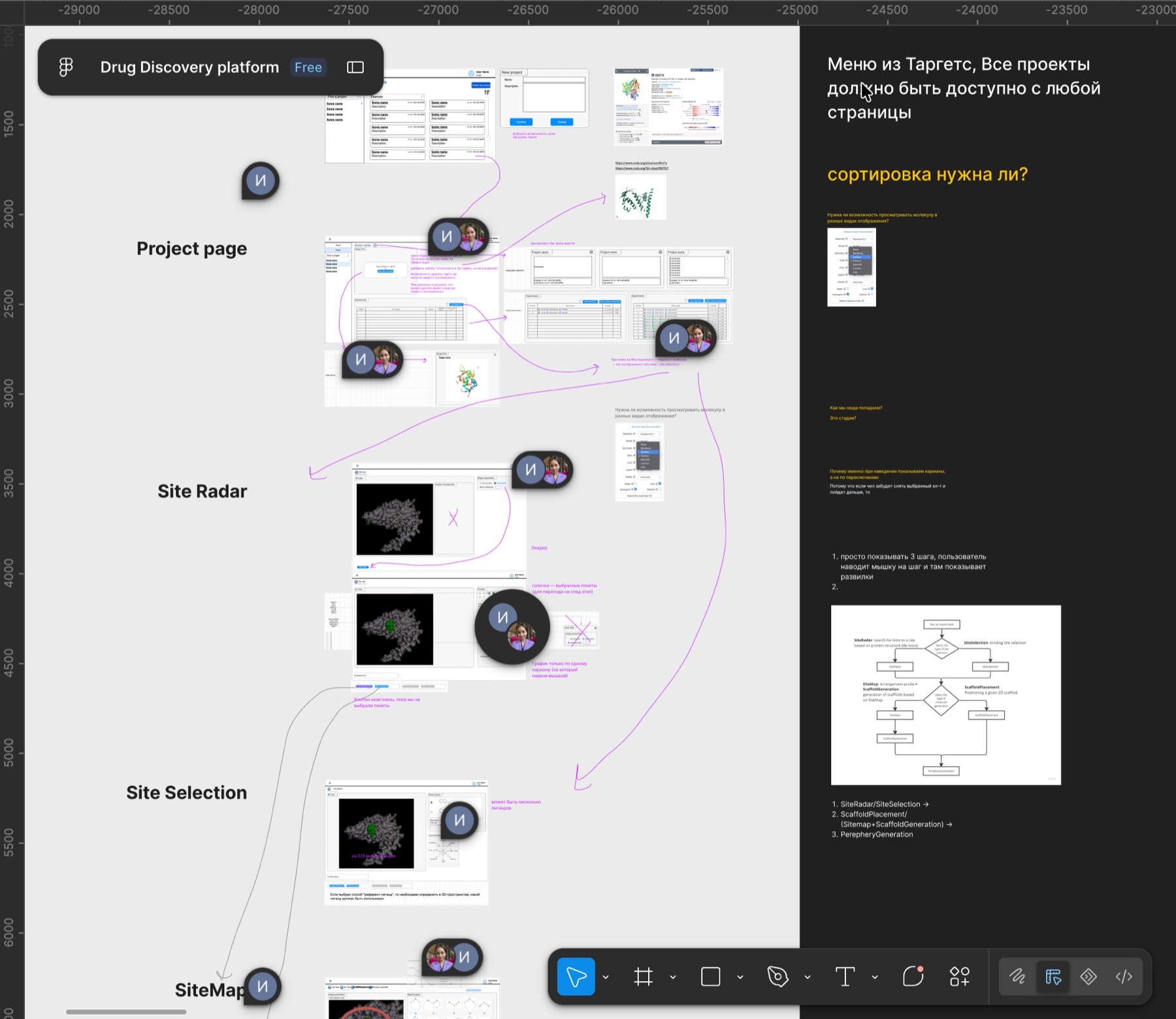
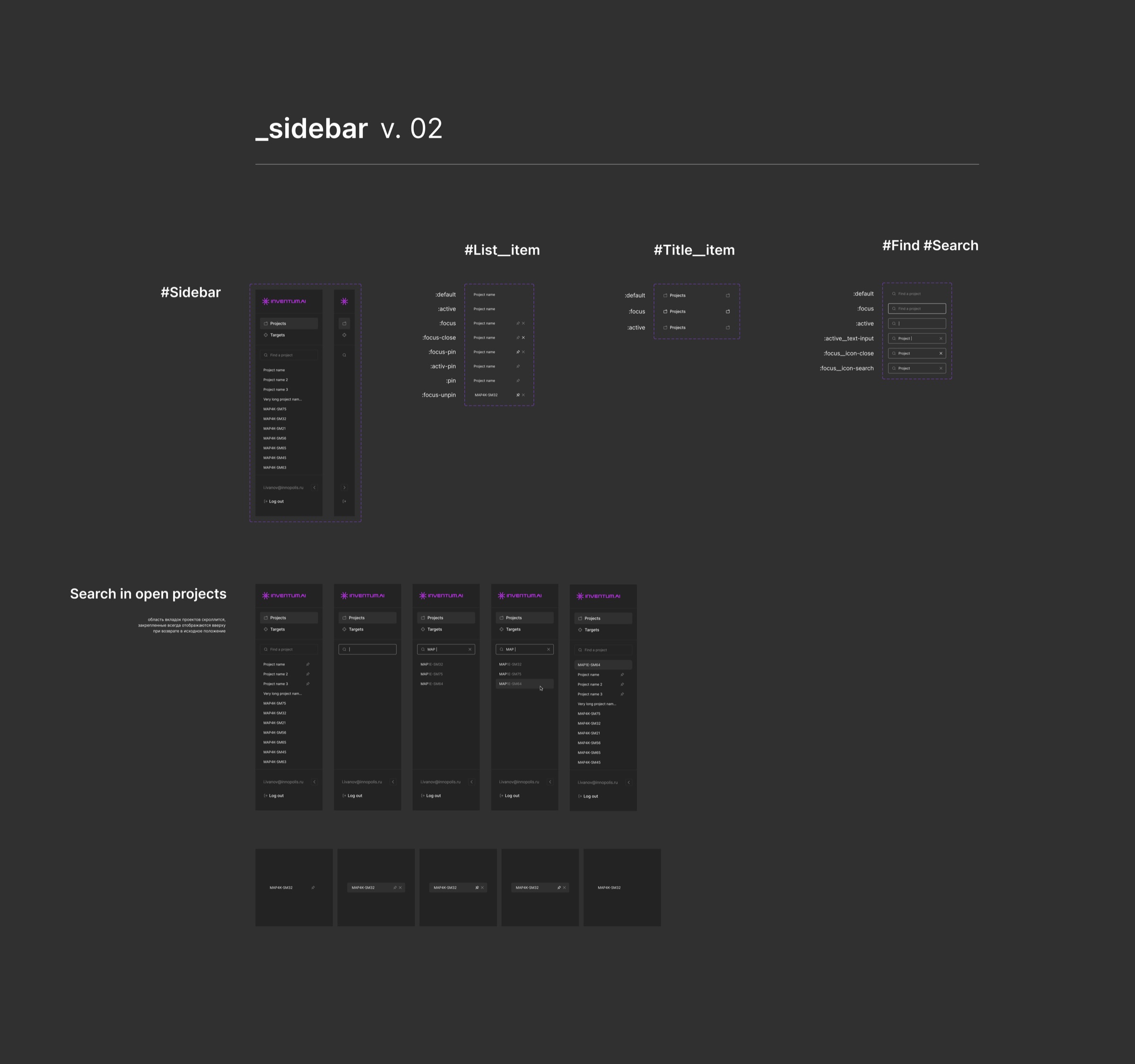
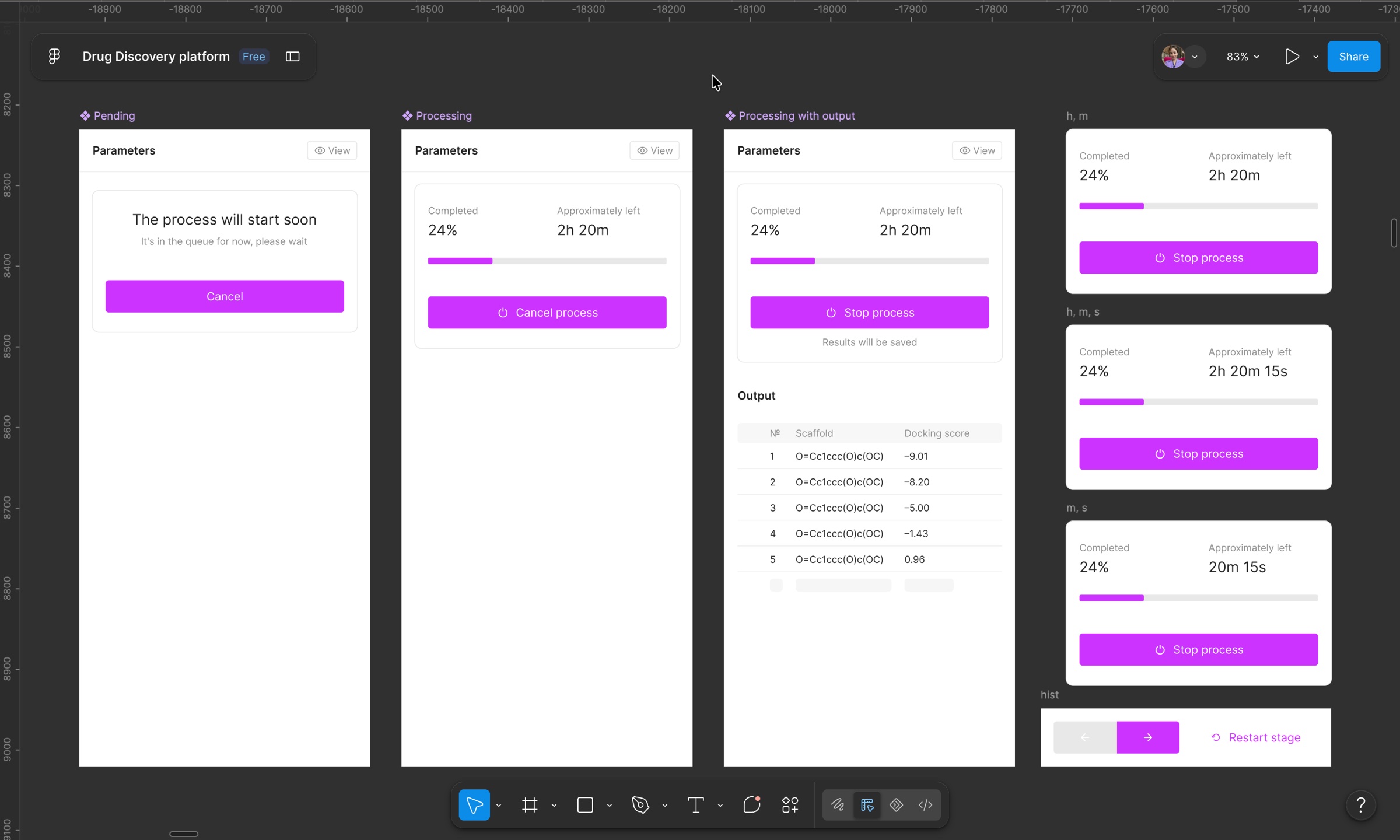
This is only a small part of the screens. For this product I designed hundreds of pages and states, dozens of presentations and other materials. And there were earlier versions before the current one — from the first, built on knowledge graphs, to the rethought Inventum.ai platform. It’s one of my most challenging and favorite projects, and I’m proud of it.
QSAR.ME is a presentation website for a B2B service that predicts the biological activity of molecules using QSAR models and deep docking. The product targets pharma companies and R&D teams that need to select promising candidate molecules at the preclinical stage of drug development.
The website explains the technology through the Complex Approach section, a step-by-step description of the pipeline: preparing a library of 10 million molecules and generative models, receptor preparation, training and inference of the docking model with candidate ranking, ADMET filtering, an IP (patent clearance) check and a retrosynthesis proposal. Then the page shows the service’s advantages, the cooperation process step by step, tables with model metrics (acute toxicity and Tox21 benchmarks compared with other architectures), a section with ready-made datasets for sale (ADMET and QSAR), case studies (including the Open Catalyst Challenge and MCL-1 and GCPII screening) and a list of the team’s scientific publications, ending with a contact form. By structure, the site primarily sells the team’s expertise through cases, metrics and publications, while selling ready-made datasets is a secondary offer.


I designed a dedicated logo for the project
Besides research, the AI in Medicine Lab team annotates medical data. The head of the lab, Ilya Pershin, invented and developed an eye-tracker-based touchless annotation technology that speeds up annotation many times over.
Manually annotating a CT/MRI scan on the existing platform takes 3 to 8 hours, and highly specialized expert annotators are scarce. In the experiment, gaze-based annotation was twice as fast as manual annotation.
I defined the project goals. Preliminary tests showed that we definitely could and should improve the speed of work in the software.
Together with the head of the lab, we started research. I drew up a plan for in-depth interviews with potential users: annotators and clinics that could adopt our product. Respondents included the head of the radiotherapy department at the Republican Clinical Oncology Dispensary, a radiologist from the University of Pittsburgh and several annotators of different specializations from the dispensary.
Exploring the market from the inside, we saw the potential to build software not only for ourselves and our annotators, but also to sell the solution to clinics. I prioritized the backlog of hypotheses and problems by impact and feasibility and wrote user stories.


The Artificial Intelligence Institute at Innopolis University brings intelligent solutions to industry, medicine and new materials. The landing page gathers in one place everything the institute can offer businesses: products and microservices, team expertise, ready-made business services and numbers that prove its experience.
There was no brief — it was my initiative: in 2023 I offered the institute a design for a new landing page together with a logo.
Everyone liked the design, but it was never built: the budget wasn’t approved, and then internal reorganization began. The logo stuck, though — it’s used as the avatar for corporate chats.


The mark is a wave that forms three letters “И” — ИИИ, the Russian abbreviation for the Artificial Intelligence Institute. I also used it as a brand element: a heading underline, the footer background and link hover. Today the logo lives on in corporate chat avatars.


In 2022 our student team (later the Yuzhny Gerion studio) was approached by STATERA, a Russian manufacturer and supplier of railway scales. They needed a platform design: admin panel screens and the B2C part of the service.
I designed strictly to the spec — see the “requested vs. delivered” example below. I offered the client two concepts, in light and dark themes; they chose the dark one.
In the end we went far beyond the contract: together with the client we came up with new useful pages. Front-end development and database work ran in parallel with design — all screens were successfully implemented.


The mark is inspired by the road: a railway track bends into the letter S. I turned the same curve into a brand pattern.

Swize is a mobile app for virtual clothing try-on: shoppers create a 3D model of their body and try on items from partner stores, while stores add products with size charts. It’s a commercial innovation project by an entrepreneur from Rostov-on-Don that started in 2020, at the height of COVID.
I was part of an outstaffing team of students who decided to build services and earn from it. From 2020 to the end of 2023 I designed two versions of the app (there were two investment rounds), a web version and guides for partners on connecting the service.
The project passed all tests and is fully ready for launch: the apps run on iOS and Android and are about to appear in the stores. The project is currently supported by Skolkovo.


Sign-up via email or social networks and choosing a role: shopper or store


General info, body type, exact measurements and photos — the model is built from them


Catalog by store and across all products, favorites and trying on the chosen size on your own model


Store info, sign-in settings and subscription


Category, product card, size chart with a hint on how to measure the item, and the finished storefront


⌘ or Ctrl + scroll — zoom, drag — pan
Tap to open the diagram
Normi is a service that collects lab results from any lab in one place. The user uploads a PDF, the system recognizes the values and turns scattered files into a clear history: a table with highlighted deviations, trend charts and a report for the doctor.
The key difference from a one-off chatbot interpretation is context. Normi knows the whole history and says not “ferritin is low,” but “ferritin has been falling for the third test in a row while C-reactive protein is rising — worth discussing with your doctor.”
This is my own project, born out of personal pain. Lab results arrive as PDF files by email, every lab has its own portal, and neither the patient nor the doctor can see the trend — only a snapshot on a given date. Worrying trends go unnoticed until they become a problem.
I went from market and competitor research to a CJM, feature prioritization and MVP design.


InnoPolim is a working tool for a lab that develops polymer films. It’s used to launch formulation generation and property prediction, and then to track every run: who created it, for which film and at what stage it is.
The main screen is the run log: a dense table with statuses, filters, export and bulk actions, plus active runs in the side menu to quickly get back to current work.


⌘ or Ctrl + scroll — zoom, drag — pan
Tap to open the diagram


